
The North Shore Marine Transfer Station is located in College Point near New York City and LaGuardia Airport. It is expected to open in the spring of 2013 and will transport approximately 3,000 tons of garbage from the Queens borough by barge to landfills each day.
The facility is enclosed to limit bird attraction, which can be very detrimental to airplane traffic at nearby LaGuardia Airport. It was the birds, after all, that were sucked into both engines of Capt. Chesley “Sully” Sullenberger’s airplane caused him to ditch in the East River. The North Shore transfer station is only 735 yards from one of LaGuardia’s runways.
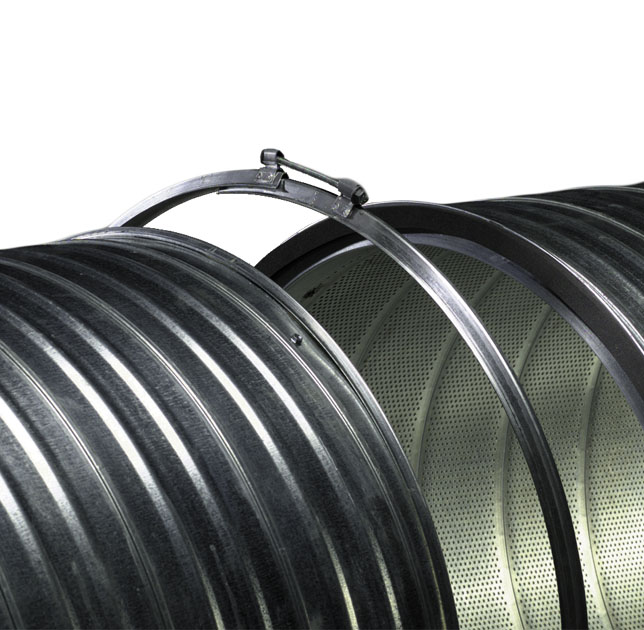
The spiral duct manufacturer on the project is Southern Tier Custom Fabrication, located in Elmira, New York. Southern Tier has been a loyal user of Ductmate products for many years, especially the Spiralmate® round duct connector system. Southern Tier Vice President Ian Morrell is very proud of the company’s relationship with Ductmate.
“We really believe in Ductmate’s innovative approach, especially with products like Spiralmate,” Morrell said. “They are easy to install and are real time savers in the shop and in the field.”
Morrell also stated that the company has been incorporating the Ductmate line into its fabrication process for approximately 30 years. He said they are also installing contractors, although not on this particular project.
Because the North Shore Transfer Station is a marine facility, it is naturally in a corrosive environment. The saltwater air will eventually start corroding any steel product, including galvanized spiral ducting. The project was specified with 316 stainless steel to counter the corrosive seawater environment and any toxic off-gassing from the trash.
Stainless steel is also very expensive, almost five times that of regular steel, and Morrell emphasized that the spiral ducting must be installed correctly and without any damage.
Morrell said Ductmate offers its Spiralmate in a variety of materials, including galvannealed, aluminized, 304 stainless, 316 stainless, and PVC-coated. Additionally, the Spiralmate features a sealing mastic in the pocket of the flange, eliminating the need for manual sealant application during assembly. Ductmate guarantees the flange will seal from 18’’ positive to 10’’ negative w.g. The mastic is non-hardening and non-drying and will not crack when transported to the shop site by truck.
The sheet metal contractor on the project is Delta Sheet Metal Corporation, located in Long Island City, NY. Delta is part of PJ Mechanical, a mechanical contractor founded in 1971 that serves the greater New York City real estate market.
Delta Sheet Metal Senior Project Manager Jacob Pierides noted that the installation differed from typical spiral projects.
The overall size of the facility measures 260’ by 215’ and consists of three levels. The tipping floor, approximately 26’ above the pier, is where the large trash trucks enter and unload their waste. The waste falls to the loading section 10’ below, where heavy equipment collects and tamps the trash into compact bundles. These trash bundles are then loaded onto barges 16’ lower at the pier level, where they are taken for eventual burial.
The facility requires constant ventilation due to the unpleasant odor of refuse and exhaust gases from the trucks. Due to the high volume of ventilation required, the facility features 28 fans, with 18 located on the mezzanine level. These 18 fans are all connected to the spiral ducting with runs along the station ceiling.
In all, approximately 3,800 linear feet of stainless spiral ducting was installed at the transfer station in a variety of sizes from 10” to 62”, with 1,400 feet sized at 52”. Over 1,200 stainless steel Spiralmate connectors of all sizes were used to attach the ducting.
The highest point in the trash facility is 62’, making the installation rather treacherous at times! For ductwork 42” or less in diameter, Pierides said the sections were manufactured in 10-foot lengths. Ductwork above 42” in diameter was manufactured in 5 long sections. All sections were assembled piece by piece in the air.
“Spiralmate made it easier to connect spiral ductwork 60 feet up in the air,” Pierides mentioned. “The one-bolt closure band accelerates installation time in the field compared to bolting the flanges together. Using Spiralmate connections helped with the production and quality of the spiral ductwork installation.”
He said that by using Spiralmate connections, they did not have to add any additional stiffeners to the duct. That made production in the shop and installation in the field more efficient. It also made it safer by reducing the possibility of a section accidentally coming loose while workers were in the air.
Pierides also concluded that the Spiralmate duct connectors helped maintain the spiral ducting’s shape. Using Spiralmate connections made the installation of the spiral ducts on this project possible. It allowed the spiral duct to maintain its shape after installation by adding rigidity to the overall structural product.