PROseal Spray Duct Sealant Shortens Application Time by 50%
Studies and testing have demonstrated that heating and cooling systems can lose up to 30% of their efficiency due to leaks in the duct joints and seams. One solution is to seal the ductwork at the joints with gasket material supplied by the manufacturer. Another is the application of duct sealant that can be applied at the joints as well as duct seams for a tight connection.
New standards in the building industry now require all ducting to be sealed to prevent air leakage. Not only does it save energy, low leakage reduces the load on the heating and cooling equipment.
Scott Schindler, owner of Schindler Heating & A/C, Inc., runs his business in Boonville, IN. For over 15 years he has installed and serviced air conditioning and heating equipment in southern Indiana.
Schindler has four employees and works primarily on residential and light commercial housing. As a businessman, he believes every job he does gets 110% of his efforts—a main reason he is the HVAC installer choice for many of the largest builders in his area.
Schindler has used Ductmate’s PROseal mastic for many years. Like most duct sealants, it is applied manually and can take an entire day to finish one house. The results were always good, but if you are not careful you can wear as much as you apply.
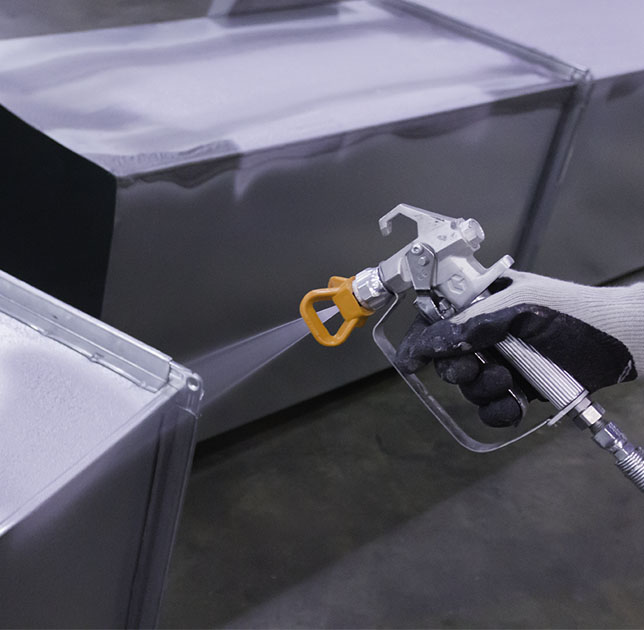
While picking up materials at Wilhite Supply Co, his local Ductmate distributor, Schindler was introduced to PROseal Spray, Ductmate’s premium water-based, high velocity duct sealant that can be applied using a wide range of sealant application equipment. It was love at first sight!
“I’m somewhat of a tool nut and am interested in anything mechanical,” said Schindler. “The fact that you can apply duct sealant using a spray system really intrigued me; five minutes later I was a believer.”
Schindler had investigated other brands of spray mastics as well but found one major problem. Most sealant manufacturers strongly recommended using their spray system. These systems cost on average $7,500 a unit, a greater investment than he wanted to make.
“We found out that Ductmate’s PROseal Spray can be used with a variety of spray systems with no problems in application or performance,” said Schindler. “In the end I purchased a sprayer for $1,700, and that was even for a slightly better unit than I needed.”
Christian Nauman, Sealants & Adhesives Product Line Manager for Ductmate, says ProSeal® Spray offers contractors benefits other than speed of application. “Ductmate formulated ProSeal® Spray as an extension of our manually-applied ProSeal® product,” said Nauman. “Both are designed to seal metal and metal joints against air leaks in low, medium, and high pressure duct systems up to 15” w.g.”
ProSeal® is a premium water-based high-velocity duct sealant that is non-flammable with a low odor and low VOC off-gassing. This is important for contractors working in tight spaces for prolonged periods of time.
ProSeal® Spray has excellent adhesion to all types of metals, and will not drip or sag under normal application conditions. The sealant has a very low shrinkage rate and remains permanently flexible over the life of the product. It is also UV, water and mildew resistant, and can be used on painted latex or epoxy finishes.
Upon using the PROseal Spray for the first time Schindler said he was a little apprehensive it would work as promised because of the viscosity of mastic. It didn’t take long to convince him otherwise.
“Our sprayer has a 150 foot hose allowing us to reach most of the house without moving the unit,” Schindler remarked. “We can finish an entire house in 30 minutes compared to an entire day using manual application.”
Many of the builders Schindler works with construct Energy Star homes. These buildings have to pass strict requirements minimizing air leakage for the building as well as the HVAC ducting. Schindler sprays all seams and joints with PROseal Spray with great success.
Schindler says his duct installations always pass with ease, and the inspector says his work is the best he has ever seen.
Once finished, the spray unit must be cleaned before the mastic hardens. Schindler says all that is needed are a few gallons of hot water that he runs through the sprayer until it runs clear. Since PROseal Spray is water-based, no harsh cleaners are required.
In addition to duct sealing, Schindler has found another use for the product. With PROseal Spray’s excellent adhesive qualities, he uses it to seal holes and cracks in the building that he may come across in places like crawl spaces.